

Automotive Navigation Systems Market to Reach USD 64.2 Billion by 2035 at 8.4% CAGR
Automotive Navigation Systems Market1
The Automotive Navigation Systems Market was valued at USD 28.7 billion in 2025 and is projected to grow from USD 31.1 billion in 2026.
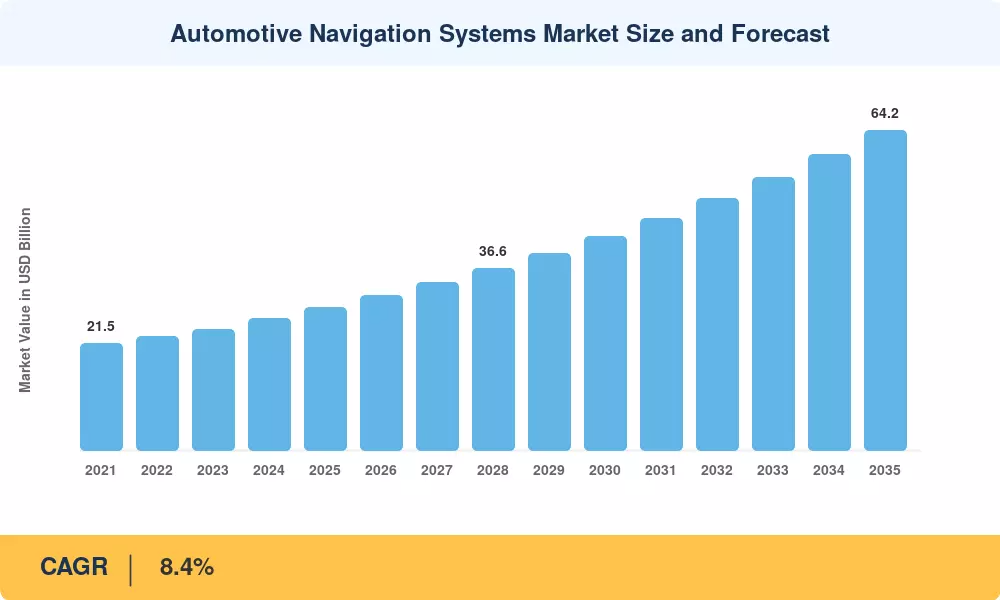
The Automotive Navigation Systems Market was valued at USD 28.7 billion in 2025 and is projected to grow from USD 31.1 billion in 2026 to USD 64.2 billion by 2035.”
NEW YORK, NY, UNITED STATES, July 23, 2026 /EINPresswire.com/ -- The Automotive Navigation Systems Market was valued at USD 28.7 billion in 2025 and is projected to grow from USD 31.1 billion in 2026 to USD 64.2 billion by 2035, registering a CAGR of 8.4% during the forecast period (2026–2035).— Arti Dhapte
Market Overview
Automotive navigation systems are sophisticated electronic platforms that determine a vehicle's position and guide drivers to their destinations using a combination of satellite positioning, digital mapping, and real-time data integration. These systems have evolved from simple standalone GPS units into complex, connected platforms that integrate with vehicle sensors, cloud services, and infrastructure networks. Modern navigation solutions provide not only turn-by-turn directions but also real-time traffic updates, dynamic rerouting, points of interest, and increasingly, EV range-optimized routing and high-definition mapping for autonomous driving. The market encompasses hardware (displays, GNSS receivers, sensors), software (map databases, routing algorithms, AI layers), and services (OTA updates, traffic data feeds, subscription platforms), serving both passenger and commercial vehicles.
Two catalysts are accelerating this trajectory: the European Union's Intelligent Transport Systems Directive mandating cooperative navigation infrastructure across all new vehicle platforms by 2028, and the U.S. Department of Transportation's USD 7.3 billion allocation for connected vehicle corridors under the Bipartisan Infrastructure Law. These policy commitments are converting navigation from a convenience feature into regulated safety infrastructure.
A fundamental technology shift is reshaping the Automotive Navigation Systems Market. Legacy standalone GPS units with static map databases are giving way to cloud-connected, sensor-fused platforms that combine satellite positioning with camera, LiDAR, and V2X inputs. Automakers invested an estimated USD 4.1 billion collectively in embedded navigation R&D during 2024 alone, with a growing share directed toward high-definition mapping layers that support Level 3+ autonomous driving functions. The transition is not incremental — it represents a platform-level architectural change in how vehicles perceive and interact with road networks.
Industry trends indicate a decisive shift toward connected, cloud-based, and subscription-driven navigation solutions. Cloud-connected navigation solutions are expanding at a CAGR of 11.2% during 2026–2035, outpacing offline-first architectures by a wide margin. Automakers are reorganizing their business models to prioritize recurring software revenue, with navigation serving as the focal point of this approach. Tiered navigation subscription plans that restrict premium features—including live traffic rerouting, satellite imagery overlays, and predictive arrival intelligence—to monthly or annual fees are fundamentally altering the unit economics by generating an enduring revenue stream over the vehicle's lifespan.
Technological developments are rapidly expanding the market's capabilities and value proposition. Machine learning models trained on billions of trip patterns can predict congestion in advance and dynamically adjust routes based on predicted traffic conditions. HD maps with lane-level accuracy, 3D semantic layers, and real-time change detection represent a premium product category commanding 3–5x higher per-vehicle licensing fees than traditional navigation databases. The decision layer between EV vehicles and charging networks is being established by navigation platforms that incorporate real-time charging station availability, pricing, and reservation capabilities, creating commission-based revenue models.
Policy and regulatory influence on the market is substantial and growing. The UNECE approved Regulation No. 157 for Automated Lane Keeping Systems, which mandates real-time, centimeter-accurate map layers as a prerequisite for type approval in over 60 countries. The European Commission's C-ITS corridor program connects over 4,000 km of major highways with cooperative infrastructure. China's Ministry of Industry and Information Technology committed RMB 50 billion (approximately USD 6.9 billion) to intelligent transportation infrastructure. The EU's eCall mandate and C-ITS Delegated Regulation have made connected navigation infrastructure a compliance requirement.
The demand outlook remains positive, with the market poised for sustained growth through 2035. North America commands the largest share at approximately 32%, driven by high OEM embed rates and robust connected-car subscription revenues. Asia-Pacific is the fastest-growing region with a projected CAGR of 10.1%, fueled by surging vehicle production in China and India alongside aggressive smart-city investment programs. Europe holds approximately 28% of the global market, anchored by stringent eCall and C-ITS mandates.
📍 Get Free Sample Report for Detailed Market Insights:
https://www.marketresearchfuture.com/sample_request/7865
Market Segmentation
By Component
The market is segmented by component into Hardware, Software, and Services. Hardware remains the largest revenue component at approximately 42% share, encompassing high-resolution displays (evolving from 8-inch to 12+ inch screens), multi-constellation GNSS receiver modules, inertial measurement units, and dedicated system-on-chip processors. Software is the fastest-growing component at a 10.6% CAGR, reflecting the industry's pivot toward recurring revenue through map database licensing, real-time traffic data integration, voice-assistant navigation layers, and AI-powered predictive routing algorithms. Services account for USD 5.7 billion in 2025, including OTA updates, traffic data feeds, and subscription platforms.
By Vehicle Type
Vehicle type segmentation covers Passenger Vehicles and Commercial Vehicles. Passenger vehicles represent approximately 74% of total demand, reflecting higher per-unit attach rates relative to commercial fleets, driven by consumer expectations for seamless smartphone integration and real-time traffic awareness. Commercial vehicles are the fastest-growing segment at a 9.6% CAGR, driven by fleet telematics integration and regulatory mandates for digital tachograph-linked routing, as fleet operators quantify navigation ROI in fuel savings and delivery efficiency.
By Technology
Technology segmentation includes Embedded (OEM-Installed), Tethered (Smartphone-Projection), and Integrated (Hybrid Cloud). Embedded OEM navigation platforms account for roughly 58% of total market revenue, reflecting automaker strategies to lock in recurring software subscription income. Tethered systems using smartphone-projection protocols account for approximately 22% share, offering a cost-effective path for mid-range and entry-level vehicles. Integrated hybrid cloud architectures are the fastest-growing segment at a 12.3% CAGR, combining local processing reliability with cloud-powered intelligence.
By Region
Regional segmentation includes North America, Europe, Asia Pacific, South America, and the Middle East and Africa. North America leads with an estimated 32% share. Asia-Pacific is growing at 10.1% CAGR through 2035. Europe holds approximately 28% of the global market.
🛒 You can buy this market report at:
https://www.marketresearchfuture.com/checkout?currency=one_user-USD&report_id=7865
Regional Analysis
North America
North America commands the largest share of the Automotive Navigation Systems Market at approximately 32%, driven by high OEM embed rates and robust connected-car subscription revenues. The United States anchors regional demand at approximately 78% of regional share, through a combination of high new-vehicle transaction prices—exceeding USD 48,000 on average in 2024—and aggressive OEM strategies to monetize embedded navigation via subscription tiers. Canada grows at a 7.8% CAGR, with cold-weather routing demand and V2X pilot programs. Mexico contributes USD 0.6 billion in 2025, serving as a growing vehicle assembly hub. The U.S. Department of Transportation's USD 7.3 billion allocation for connected vehicle corridors under the Bipartisan Infrastructure Law is creating a robust demand floor.
Europe
Europe holds approximately 28% of the global market, anchored by stringent eCall and C-ITS mandates. Germany leads regional demand at approximately 27% of European share, as home to BMW, Mercedes-Benz, and Volkswagen, concentrating navigation R&D investment and creating a technology leadership dynamic. The United Kingdom grows at an 8.5% CAGR, with connected vehicle regulation and congestion-zone navigation driving demand. France contributes USD 1.1 billion in 2025, with Renault-Stellantis embedded platform investments. European regulatory frameworks—particularly the eCall mandate and C-ITS Delegated Regulation—have made connected navigation infrastructure a compliance requirement rather than an optional feature.
Asia-Pacific
Asia-Pacific is the fastest-growing region with a projected CAGR of 10.1%, fueled by surging vehicle production in China and India alongside aggressive smart-city investment programs. China accounts for approximately 46% of regional share, through sheer production volume—over 30 million vehicles manufactured annually—combined with a domestic mapping ecosystem controlled by Baidu Maps, AutoNavi (Alibaba), and Tencent Maps. Japan grows at an 8.9% CAGR, with autonomous driving legislation and precision positioning investment. India contributes USD 0.9 billion in 2025, representing the fastest-growing volume opportunity through affordable vehicle segment growth and smartphone-projection navigation adoption.
South America
South America represents a smaller but growing market, with Brazil accounting for approximately 62% of regional revenue. Brazil's dominance in South American vehicle sales—exceeding 2.3 million units annually—positions it as the primary market revenue center, with ride-hailing platforms like 99 and Uber creating commercial demand for reliable navigation solutions. Argentina grows at a 7.2% CAGR, with urban navigation demand and aftermarket retrofit market growth.
Middle East & Africa
The Middle East & Africa region, valued at USD 1.5 billion in 2025, is driven by smart-city mega-projects and luxury vehicle import demand. The UAE accounts for approximately 28% of regional share, with smart-city initiatives (NEOM, Dubai) and luxury vehicle imports driving premium-tier navigation system demand. Saudi Arabia grows at a 9.3% CAGR, with Vision 2030 infrastructure spending and new-city developments. Africa's contribution remains limited by low new-vehicle sales volumes, though South Africa and Nigeria show emerging aftermarket navigation demand.
Competitive Landscape / Key Players
The Automotive Navigation Systems Market is moderately concentrated, with the top five players accounting for roughly 38–44% of global revenue. Key companies operating in this market include Robert Bosch (~8–11% share), HERE Technologies (~7–10%), Garmin (~6–9%), TomTom (~5–8%), Harman International (Samsung) (~5–7%), Denso (~4–6%), Pioneer (Forvia) (~4–6%), Alpine Electronics (~3–5%), Continental AG (~3–5%), and Mitsubishi Electric (~2–4%).
Strategic developments in the market include significant investments and partnerships. In January 2024, Denso Corporation established a joint venture with NTT Data to develop real-time dynamic map services for autonomous vehicles in Japan, with initial deployment planned for 2026. In April 2024, the U.S. Department of Transportation awarded USD 1.6 billion in grants for connected vehicle corridor infrastructure across 12 states, directly expanding the addressable data ecosystem for in-vehicle navigation. In October 2023, the European Commission published updated C-ITS technical specifications requiring Day-1 service integration in all navigation-equipped new vehicles sold in the EU from 2027.
Competitive differentiation increasingly hinges on HD mapping capabilities, subscription platform sophistication, and integration with autonomous driving stacks. Competition spans traditional Tier-1 automotive suppliers, technology giants, and specialized mapping companies, creating a layered competitive structure where hardware, software, and data capabilities each represent distinct battlegrounds.
Latest Industry News & Developments
Recent industry developments highlight the ongoing transformation of the automotive navigation systems market toward connected, cloud-based, and autonomous driving-enabled solutions. In April 2024, the U.S. Department of Transportation awarded USD 1.6 billion in grants for connected vehicle corridor infrastructure across 12 states, directly expanding the addressable data ecosystem for in-vehicle navigation.
In January 2024, Denso Corporation established a joint venture with NTT Data to develop real-time dynamic map services for autonomous vehicles in Japan, with initial deployment planned for 2026. This partnership reflects the growing importance of HD mapping for Level 3+ autonomous driving.
In October 2023, the European Commission published updated C-ITS technical specifications requiring Day-1 service integration—including hazardous location warnings and in-vehicle speed limits—in all navigation-equipped new vehicles sold in the EU from 2027, reinforcing the regulatory shift toward connected navigation infrastructure.
Market Challenges & Opportunities
Key restraints facing the automotive navigation systems market include the smartphone substitution effect, with 47% of new vehicle owners with embedded navigation systems still defaulting to their smartphones for turn-by-turn directions. High embedded system cost burden for OEMs, adding USD 250–600 to per-vehicle bill-of-materials costs, particularly challenging in sub-USD 20,000 vehicle segments. Data privacy and localization regulations, including GDPR, China's Personal Information Protection Law, and surveying and mapping laws that mandate domestic server processing, create a regulatory patchwork that impedes product launches. Map data freshness and accuracy gaps, and cybersecurity vulnerabilities in connected navigation further constrain growth.
Emerging opportunities in the market are substantial and diverse. High-definition mapping for autonomous vehicle stacks presents a significant opportunity, with HD maps with lane-level accuracy and 3D semantic layers commanding 3–5x higher per-vehicle licensing fees. Navigation-as-a-service subscription models offer OEMs USD 120–300 per vehicle per year in recurring revenue, compared to a one-time USD 500–800 license payment. Emerging-market leapfrog via smartphone-integrated navigation opens the market to vehicle segments previously considered unaddressable, as wireless projection protocols deliver near-native display quality at a fraction of embedded system cost.
Future potential lies in EV charging network integration and data monetization, with navigation platforms incorporating real-time charging station availability and pricing creating commission-based revenue models as the global public charging network is expected to surpass 15 million stations by 2030. Fleet and commercial vehicle navigation optimization represents high-value customers willing to pay premium prices for predictive traffic and multi-stop optimization engines. AI-powered predictive navigation will become a standard feature in 65% of new vehicles sold in developed markets by 2030. Autonomous vehicle navigation architecture demands machine-readable route plans with unprecedented accuracy and reliability. Data sovereignty and localized navigation ecosystems will likely operate through three to four quasi-independent mapping platforms rather than a single global standard.
To explore more market insights, visit us at:
https://www.marketresearchfuture.com/reports/automotive-navigation-systems-market-7865
Final Market Summary
The automotive navigation systems market is positioned for strong growth through 2035, driven by autonomous driving regulation acceleration, connected car subscription revenue models, EV proliferation and range-optimized routing, and smart-city infrastructure investment. The projected valuation of USD 64.2 billion reflects rapidly expanding adoption across all vehicle types and technologies, with the market transitioning from legacy standalone GPS units to cloud-connected, sensor-fused, and subscription-enabled platforms.
The medium-term growth outlook remains positive, with the market registering a CAGR of 8.4% during the forecast period. North America will continue to maintain market leadership through high OEM embed rates and connected-car subscription revenues, while Asia-Pacific emerges as the fastest-growing region driven by vehicle production scale and smart-city investment. The ongoing development of HD mapping, AI-powered predictive routing, and EV-specific navigation features will continue to expand market possibilities and applications.
Long-term industry potential extends beyond the current forecast horizon. AI-powered predictive navigation will transform navigation from a reactive instrument to a predictive co-pilot, becoming a standard feature in 65% of new vehicles sold in developed markets by 2030. Autonomous vehicle navigation architecture will require complete rethinking, with machine-readable route plans integrating lane-level positioning and real-time object detection. Electrification and energy-aware routing will make navigation systems the critical bridge between drivers and charging infrastructure. Data sovereignty and localized navigation ecosystems will operate through multiple quasi-independent mapping platforms. Manufacturers that successfully develop HD mapping capabilities, invest in subscription platforms, and adapt to evolving regulatory requirements will capture substantial value in this evolving market. The transformation of automotive navigation from simple route guidance to intelligent, connected, and autonomous-ready mobility platforms represents a fundamental advancement in vehicle technology, enabling the next generation of safe, efficient, and electrified mobility.
More Related Reports from MRFR Library:
Motorcycle Airbag Market: https://www.marketresearchfuture.com/reports/motorcycle-airbag-market-33296
Electric Scooter Lift Carrier Market: https://www.marketresearchfuture.com/reports/electric-scooter-lift-carrier-market-33504
Automotive Adas Park Assist Market: https://www.marketresearchfuture.com/reports/automotive-adas-park-assist-market-34128
Automotive Control Arm Market: https://www.marketresearchfuture.com/reports/automotive-control-arm-market-34137
Automotive Part AfterMarket: https://www.marketresearchfuture.com/reports/automotive-part-aftermarket-market-34459
Automotive Steering Column Market: https://www.marketresearchfuture.com/reports/automotive-steering-column-market-34461
Automotive Roof System Market: https://www.marketresearchfuture.com/reports/automotive-roof-system-market-34666
Automotive Parts Components Market: https://www.marketresearchfuture.com/reports/automotive-parts-components-market-34690
Industrial Tire Market: https://www.marketresearchfuture.com/reports/industrial-tire-market-34760
Automotive Maintenance Tool Market: https://www.marketresearchfuture.com/reports/automotive-maintenance-tool-market-34861
Larry Wilson
WantStats Research And Media Pvt. Ltd.
+1 855-661-4441
email us here
Legal Disclaimer:
EIN Presswire provides this news content "as is" without warranty of any kind. We do not accept any responsibility or liability for the accuracy, content, images, videos, licenses, completeness, legality, or reliability of the information contained in this article. If you have any complaints or copyright issues related to this article, kindly contact the author above.
